



09 Feb Agoutis: The Small Rodent Making a Big Difference in Panama
By Natalie Warner
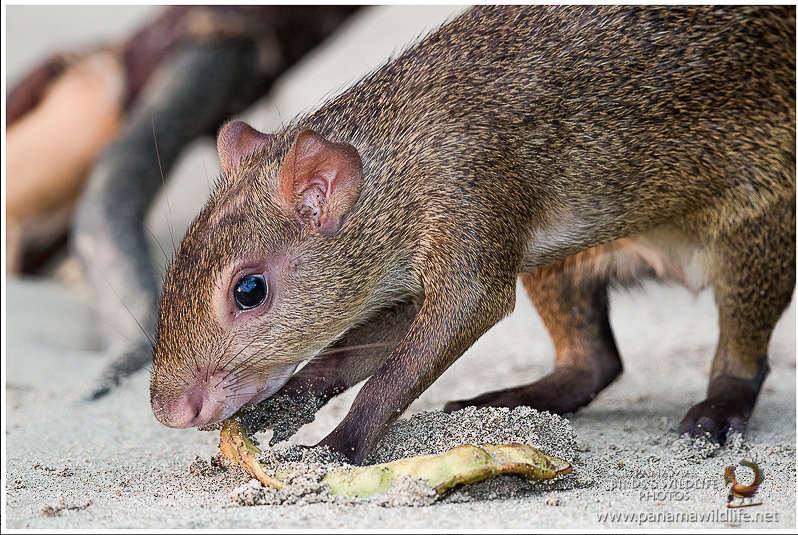
Rodents are animals that many people tend to have negative associations about. However, some can play an essential role in another specie’s survival. Agoutis, ñeque in Spanish, are cat sized rodents that can be found in Panama. Related to guinea pigs, these animals play a significant role in tree production throughout the country’s rainforests, specifically black palms.
In total, there are eleven species of agouti. They are native to Latin America and were also introduced to some countries in the Lesser Antilles. There are two species found in Panama: Central American agouti and the Coiban agouti. Central American agoutis in Panama are often found in rain forests and near water. They prefer to be in areas with a lot of cover in order to hide from predators. Coiban agoutis are only found on Coiba Island. They closely resemble the Central American agouti.
Coiban agouti source
Appearance
Agoutis weigh between 2.4-6 kg (5.3-13.2 lb) and are 40.5-76 cm (16-30 in) in length. They have five toes on each of their front feet and three toes on their back feet. The color of an agouti depends on its species. Colors can range from tones of red, orange, brown, grey, or black, with white or light brown stomachs. They have long hair on their backside, which is used to make their appearance bigger when they are threatened or are showing signs of aggression. Their life expectancy can be up to 20 years in captivity.
Reproduction
Although typically solitary and territorial animals, once agoutis find a mate, they are monogamous for life. Mates share territory; foraging usually occurs separately.
Litters range between 1-4 babies, known as pups. They are born in burrows and can walk and run within an hour of being born. Fathers are barred from the burrow when the pups are very young. Most species of agouti have one litter a year. Some species are known to have two litters each year.
Diet
Agoutis are diurnal animals, spending the majority of the day hunting and foraging for food. They are primarily herbivores and eat nuts, seeds, and tubers. Eggs, insects, and shellfish are part of an agouti’s diet when food resources are scarce. They are known to follow monkeys, waiting for them to drop fruit from tree canopies. Agoutis are also notorious at burying caches of uneaten seeds and forgetting about them.
Fun fact: Agoutis are the only mammal known to be able to break open the shell of a Brazil nut.
A Keystone Species
A keystone species is a species that has a significant impact, usually positive, on its ecosystem. Agoutis are considered a keystone species as they are largely responsible for tree reproduction. This is particularly true when it comes to Brazil nut trees in Brazil, and black palm trees in Panama.
Black palms are found throughout the rainforests of Panama. A favorite fruit of agoutis, seeds are regularly sought out along the rainforest floor. The original animal that contributed to the tree’s survival was the gomphothere. It was an elephant like animal that would eat black palm seeds, which went extinct roughly 10,000 years ago. They would spread the indigestible seeds as it roamed the Panamanian rainforests. In essence, the black palm should have gone with gomphotheres. Enter agoutis, and you have a whole new animal to help contribute to a specie’s survival.

Gomphothere source
One study examined this relationship a little bit closer to see how much of an impact agoutis actually have on the spread of black palm seeds. Scientists attached trackers to 589 seeds and placed them in 52 different sites around Barro Colorado Island in Panama. Approximately 35 percent of the seeds were scattered 100 m (109 yd) away from its starting location by the end of tracking. Most seeds were moved at least once within the first week, with some being moved up to twice in one day.
One specific seed was eaten 209 days after tracking began. During this time, the seed had moved 208 m (306 yd) and moved 36 times. Selina Haefeli states in an article, “The weirdest part about these funny rodents is that they don’t even seem all that keen on eating the seeds… Perhaps they just like the thrill of stealing them from other agoutis and hoarding them in their secret loot.
Agouti eating black palm seed source
Conservation Status and Threats
Natural predators for agoutis include ocelots, and jaguars. Human impact including deforestation and habitat loss are the biggest threat for these rodents. Polluted waterways have also negatively impacted this species.
Due to their size, agoutis are often sought out after as exotic pets. They are also hunted for their prized meat by rural tribes which is used in bartering. Although unconfirmed, this author has read tourist posts discussing eating agouti.
The International Union for Conservation of Nature (IUCN) lists the Central American agouti as least concern due to its range of habitat. Coiban agoutis are listed as vulnerable.
Agoutis play a vital role in tree reproduction and in the health of Panama’s rainforests. Who knew a rodent could be so important?