



23 Feb Tranquilo Sloths of Panama
Slow Down and Take it Easy…
When it’s too hot in the middle of the day and you want to take a siesta, you might just feel like one of the amazing animals found here in Panama; the sloth.
Three toed sloth in Gamboa
Sloths are masters of energy conservation. Something we humans try to do when we get exhausted from the heat. They eat very little and spend upwards of fifteen hours sleeping. When they’re not sleeping, they move incredibly slowly in order to make their energy last.
Both the two and three-toed sloths belong to the Pilosa mammal origin which is comprised of sloths and anteaters. But the two-toed sloth is not in the same family as the three-toed sloth. Both species evolved in similar ways and on the same timeline but they have different anatomical structures and the two species will never mate to form a hybrid due to entirely different reproductive systems. Because they are mainly solitary creatures, both species can share the same habitat.
Fun Fact
Both types of sloths have three “toes” on their back limbs. So technically the one should be called two “fingered” sloth.
Two toed/fingered sloth with baby
Sloths are found in Central and South America and here in Panama are even seen in Panama City’s Metropolitan Park. I spoke with Ursula Gonzalez, owner of Casa Mariposa in El Valle, where she cares for two sloths who came to her as babies and would not survive in the wild. She’s learned quite a bit about the species and told me, “Sloths are passionately slow, and we learn from them to slow down.”
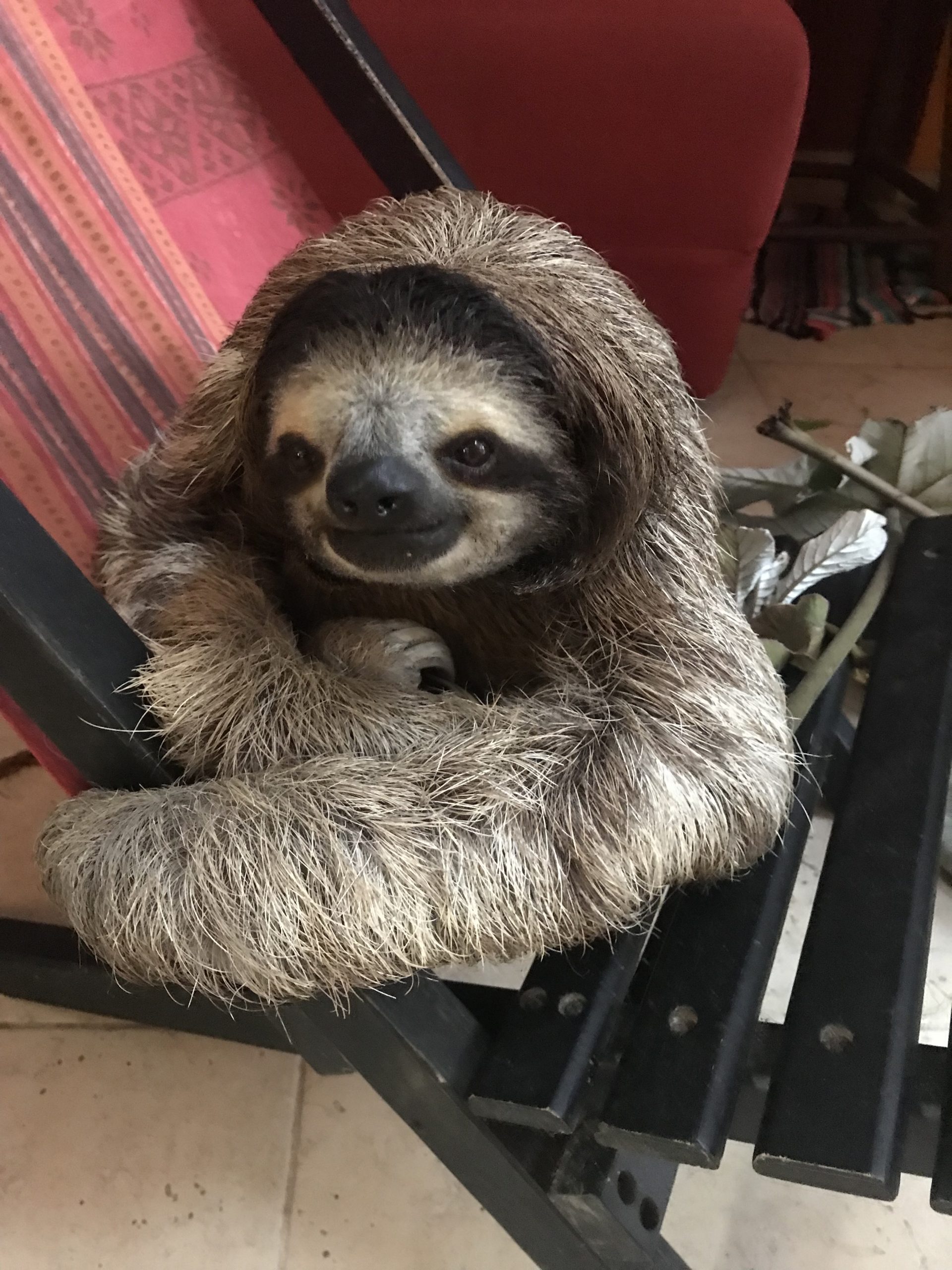
Three toed sloth at Casa Mariposa
Sloths are so lazy, they only come down from their trees once a week to eliminate waste, which they bury at the base of the tree where they live. But it is not just laziness, it is for their own protection. This is the time they are most vulnerable to predators such as snakes, harpy eagles, coyotes and jaguars.
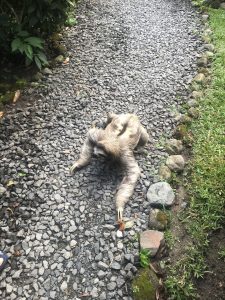
Sloth on the go
Sloth Fact
Sloths are loosing up to 1/3 of their body weight when defecating
Thankfully predators don’t often see the sloth because of their lethargy and their hair is often covered in algae, camouflaging them. Both species have long arms and small shoulder blades and their claws grip tree branches where they hang upside down instead of using energy to balance.
They may sit on top of branches on occasion, but they usually eat, sleep, and even give birth while in their hanging position.
More Sloth Facts
· Sloths sleep 15-18 hours per day (I’m jealous!)
· Sloths are good swimmers and can hold their breath underwater for 40 minutes
· Sloths have a good sense of smell but poor eyesight
· Their lifespan is 20 – 30 years
· Their preferred tree is the cecropia but they can feed and live in more than 25 tree varieties
In addition to the two and three-toed sloths, there is also an endangered pygmy sloth native to Isla Escudos in Veraguas in the Bocas del Toro region. In Panama, the main sloth sanctuary and preservation efforts are through the APPC (Asociacion Panamericana Para La Conservacion) and operates in conjunction with the Gamboa Rainforest Resort, just at the edge of the Panama Canal.
Ursula Gonzales has recommendations if you discover an injured sloth:
· In El Valle, call the Casa Mariposa +507-908-7014, or the police
· Near Panama City, call Gamboa Resort +507-314-5028
· In general, call local police who will contact the APPC
If you see a two-toed sloth crossing the road, first preference is to safely stop traffic and let the animal cross. Or, you can pick it up by the claws and move it to safety. A three-toed sloth may be more aggressive and in that case you can use a stick or your car mat to pull it to the side of the road.
The best way to see these beautiful creatures is in their natural habitat and look carefully up into the trees where you may see them hanging or curled up in the V of tree branches.
and the Coronado Concierge Team