



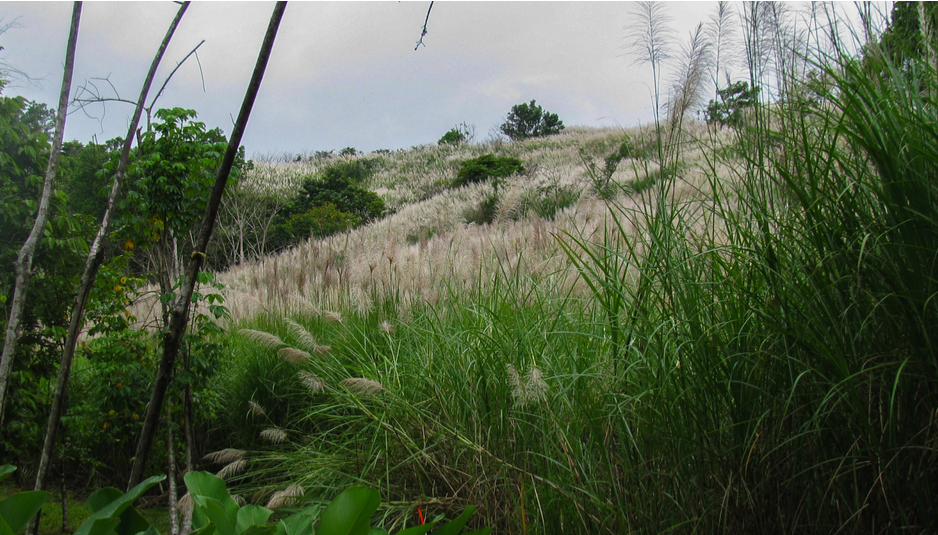
16 Mar Invasive Grass Species in Panama: Elephant Grass and Wild Sugar Cane
By Natalie Warner
Panama is no stranger to tall grasses. Many native species can be found but also several invasive species, including elephant grass (Pennisetum purpureum) and wild sugar cane (paja blanca or paja canalera in Spanish, or Saccharum spontaneum for scientific purposes). These grasses grow throughout Panama, especially the non-native species. It is hard to miss the thick foliage growing alongside the roads and…well, just about everywhere.
Articles about this topic often use Saccharum spontaneum and Pennisetum purpureum interchangeably. While similar in appearance, they are not the same. Elephant grass is considered one of the world’s most successful invasive grass species. Both grasses are native to Asia and Africa and grow up to 4 m (13 ft) tall. They thrive in tropical regions with a lot of rain. Neither grow well in areas that get frost or in shaded areas.
Both grasses have little use in Panama. Farmers in the area may dry season may use Pennisetum purpureum a in a cut and carry fodder system (where cattle are unable to graze). However, the bulk of the grass does not get used. A study conducted at the University of Panama indicates that the fibers of elephant grass may be promising as a paper substitute. This is due to the percentage yields and natural characteristics of the grass. At this point, no follow up information could be found regarding whether it is being used for this purpose.
Saccharum spontaneum has a high silica content and is not good for fodder, according to Kristin Saltonstall, a researcher at The Smithsonian Tropical Research Institute (STRI). She states that to her knowledge, there is no known use for wild sugar cane.
An Invasive Species
Wild sugar cane occupies roughly 3% of the Panama Canal Watershed. Both species of grass contribute to flooding. Deep root systems and thick leaves acts as a retaining wall and prevents soil run off. They are known to alter ecosystems as a result. They also prevent native plants from growing. In optimal conditions, some native plants are able to compete with these grasses. However, aggressive practices of getting rid of the grass by burning often inhibits this.
Saccharum spontaneum source
Burning clears out excess vegetation and allows for seeds to spread. These practices allow for native vegetation to be cleared as well, creating new areas for growth. It does not help that burning in Panama is done during dry season, which is also when the winds in the area pick up. This provides an optimal opportunity for seeds to get carried longer distances.
The regrowth of the invasive grasses has also been shown to create grass canopies that support higher amounts dead biomass which help contribute to their growth. This then creates a cycle of needing to burn more. While burning is illegal in Panama, it seems to be a widely accepted practice and is often disregarded by authorities. It is suggested that restricting burning and cutting can actually decline wild sugar cane and elephant grass populations and allow for native species to grow.
Theories on how it got to Panama
The origins of how the grasses arrived in Panama are unclear. The majority of the theories indicate that the United States was responsible, either intentionally or unintentionally. Centro Agronómico Tropical Investigaciones y Enseñanza (CATIE) believes that it was introduced by the US to prevent erosion of the Culebra Cut in the Panama Canal. The report written in 2000 did not specify the date in which the introduction occurred.
Another theory is that wild sugar cane was introduced in 1930s during Canal Zone Experiment Gardens (1939) which involved a study to determine the range of variation natural of the genus Saccharum. The idea was to develop new types of hybridization to improve sugarcane industry. While the specific species found in Panama is not named in papers, it may be safe to assume that Sacchurun spontaeum was part of the experiment.
An article states that the STRI believes Saccharum spontaneum was introduced in the 1970s. It was transported by a United States ship going through the Panama Canal who came from building an airport in Thailand.
Part of difficulty of origin of may be the distinction between native sugar cane grasses, wild sugar cane, and elephant grass not immediately made. Both are similar in appearance. Elephant grass has taller stems and narrower leaves compared to wild sugar cane grass.

Pennisetum purpureum
Efforts to Control Elephant Grass with PRORENA
Proyecto de Reforestación con Especies Nativas (PRORENA) is an ongoing project involving the STRI and Yale University. They have several locations throughout Panama in efforts to reforest areas in hopes of eliminating these invasive grasses. Elephant grass does not grow in shaded areas. The idea is to plant native tree species which should promote the growth of native plant species.
Elephant grass and wild sugar can are readily found throughout Panama. Both thrive here. While efforts are being done to help reduce the amount of invasive grasses are being done, it is likely here to stay until major education efforts are done regarding grass management.
A special thank you to Kristin Saltonstall for taking the time to answer my questions!